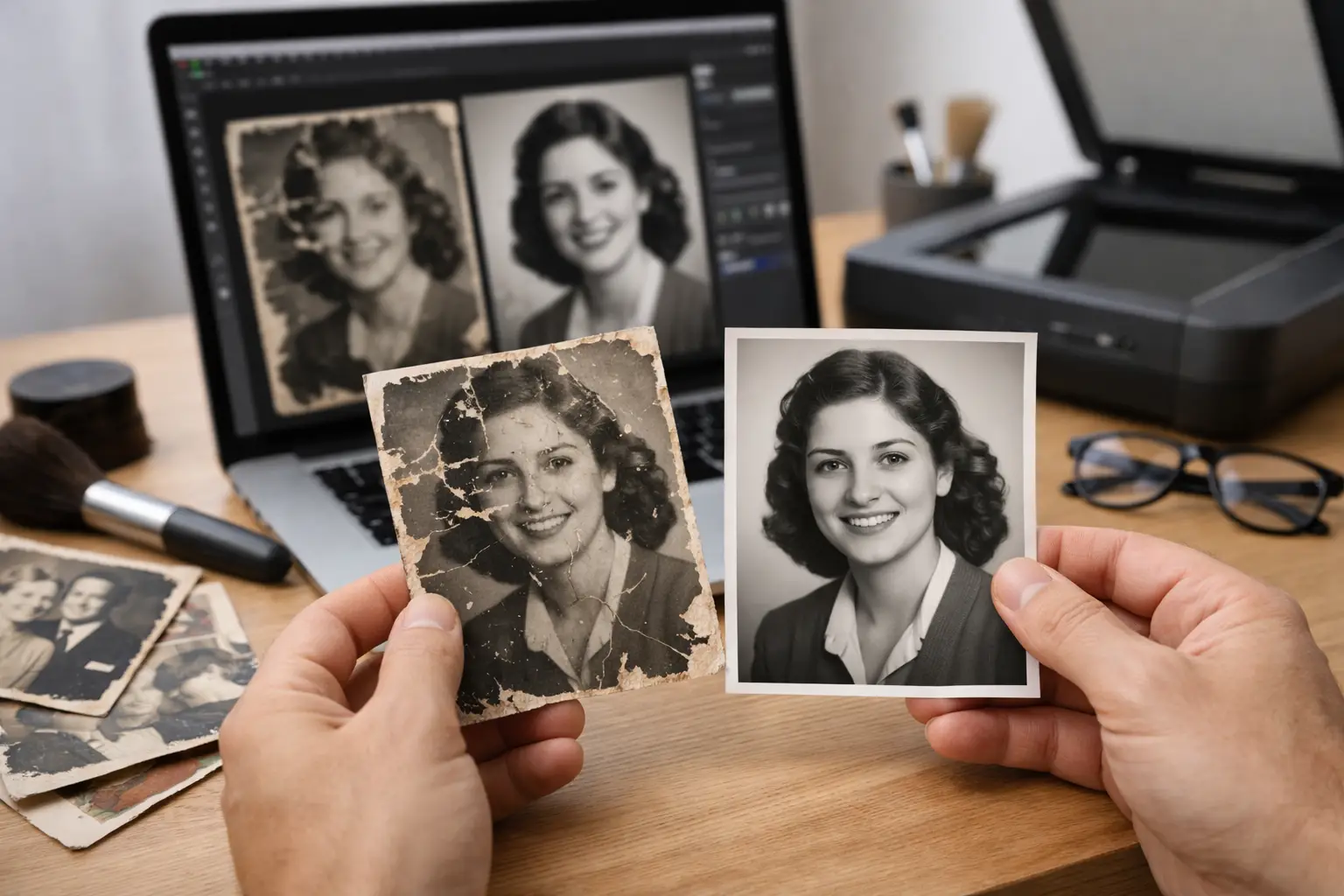
A faded wedding portrait, a torn childhood snapshot, or a box of brittle family prints can feel impossible to replace. When you search for photo repair and restoration near me, you are not simply looking for someone to improve an image. You are looking for careful help with memories that may exist nowhere else.
For families in Thousand Oaks and surrounding Southern California communities, professional photo restoration offers a practical way to renew aging photographs while protecting the original print. The goal is not to make a meaningful photo look artificial or overly polished. It is to preserve what is there, reduce visible damage where possible, and create a usable digital version for safekeeping and sharing.
What Photo Repair and Restoration Can Address
Physical photographs change over time. Sunlight fades color, humidity leaves stains, albums can transfer adhesive onto prints, and ordinary handling can create tears, creases, scratches, and fingerprints. Even photos kept in a closet may slowly deteriorate because paper, inks, and older processing materials were not designed to last forever.
Professional restoration begins by creating a high-quality digital copy. From there, damaged areas can be carefully repaired without altering the physical original. Depending on the photograph, restoration may improve fading, color shifts, scratches, dust, stains, cracks, torn edges, fold lines, and minor missing sections.
Some repairs are more straightforward than others. A small scratch across a background can often be corrected with little difficulty. Reconstructing a face that is missing, severely blurred, or covered by a large stain requires more interpretation and may not produce a perfect result. A thoughtful restoration provider should be clear about those differences before work begins.
The best results preserve the character of the original image. A 1950s print should still feel like a 1950s print, even after its contrast and color have been renewed. Restoration is about respectful repair, not rewriting family history.
Why Digitization Should Be Part of the Process
Repairing one print is valuable. Creating a digital archive gives that work lasting protection. Once photographs have been professionally digitized, families have copies they can view, organize, share, and preserve without repeatedly handling fragile originals.
A digital file also allows restoration work to happen safely. The original photograph remains intact while adjustments are made to its scanned version. This is especially important for old albums, one-of-a-kind prints, handwritten images, and photographs that could be damaged further by attempts at home cleaning or repair.
Digitization can make an entire collection more useful. Photos that have spent decades in shoeboxes or drawers can be sorted by family branch, event, approximate year, or person. Adult children working through a parent’s collection, estate organizers, and grandparents preparing photos for younger relatives often find that a digital archive makes the collection far easier to manage.
There is also a simple preservation benefit: backups. A physical collection can be lost to water damage, fire, theft, or gradual deterioration. Digital copies do not replace the value of an original print, but they provide an essential layer of security if something happens to it.
When to Search for Photo Repair and Restoration Near Me
Local service can be especially helpful when you have a meaningful collection and want to know who is handling it. Dropping off photographs in person gives you an opportunity to discuss the condition of the images, explain which photos matter most, and ask questions about the process before committing to a larger project.
This can be reassuring when the collection includes irreplaceable pieces: a grandparent’s military portrait, a damaged wedding photograph, childhood pictures of a loved one who has passed away, or family images from another country. These are not generic documents. They deserve individual attention.
A local photo preservation service may also be a better fit than a quick retail scan when you need more than basic digitization. Standard scanning can create a file, but it does not necessarily account for fading, delicate handling, orientation issues, album damage, or the judgment needed to restore a worn photograph naturally.
Photo Renew Labs serves this need by pairing photo digitization with restoration for families who want to protect and renew the photographs that matter most. The focus is on creating accessible digital files while treating original prints with care.
What to Ask Before You Hand Over Your Photos
Before choosing a provider, ask how originals are handled, how files are delivered, and whether restoration is included or priced separately. It is also useful to ask whether you can start with a small group of priority images. A test project may help you see the quality and style of the work before restoring a larger collection.
Ask about scan quality as well. Resolution affects how well a photo can be enlarged, printed, or restored. For a small snapshot meant only for casual viewing, a basic scan may be enough. For a portrait you hope to reprint, frame, or share with family members, a higher-resolution file is often worth considering.
You should also discuss your preferred restoration approach. Some families want only light corrections that retain the photo’s age and original color cast. Others want a more complete repair that reduces stains, tears, and fading as much as possible. Neither choice is wrong. It depends on how you plan to use the image and what feels true to the memory it holds.
Be cautious about anyone promising that every damaged image can be made perfect. Restoration has limits. Detail that was never captured, or that has been completely destroyed, cannot always be recovered accurately. Skilled work can make a dramatic difference, but honest expectations are part of good preservation.
Preparing a Family Collection for Restoration
You do not need to organize every photograph perfectly before bringing it in. That is often the reason people delay the project for years. Still, a little preparation can help you get more value from the work.
Start by separating the photographs you most want to save from the larger collection. These may be the images with visible damage, the only known copy of a family portrait, or photos you hope to share at an anniversary, memorial, reunion, or graduation. If you know names, dates, or locations, keep that information with the group. Even a handwritten note can help preserve context that may otherwise disappear.
Avoid trying to fix physical damage yourself. Tape can discolor and pull at photo paper. Household cleaners, water, and rubbing can remove delicate image layers. Photos stuck together or adhered to old album pages should be handled with particular care. A professional assessment is usually safer than forcing them apart.
It also helps to keep photographs away from direct sun, garages, attics, and damp storage areas while you decide what to do next. Stable indoor conditions are generally kinder to prints than heat, moisture, and dramatic temperature changes.
Restoration Is Also a Way to Share Stories
The value of a renewed photograph is often felt long after the repair is complete. A restored image can become part of a memorial table, a family history project, a holiday slideshow, or a gift for children and grandchildren. It can give relatives a reason to ask questions about people and moments they have never seen clearly before.
That is why photo preservation is worth approaching with patience. You may begin with one faded portrait and later decide to digitize an entire album. Or you may have hundreds of prints but choose to restore only a handful of significant photographs. Both are meaningful ways to move forward.
Choose the photos that pull at you first. Preserving one face, one celebration, or one piece of family history can be enough to start bringing a collection back into view.