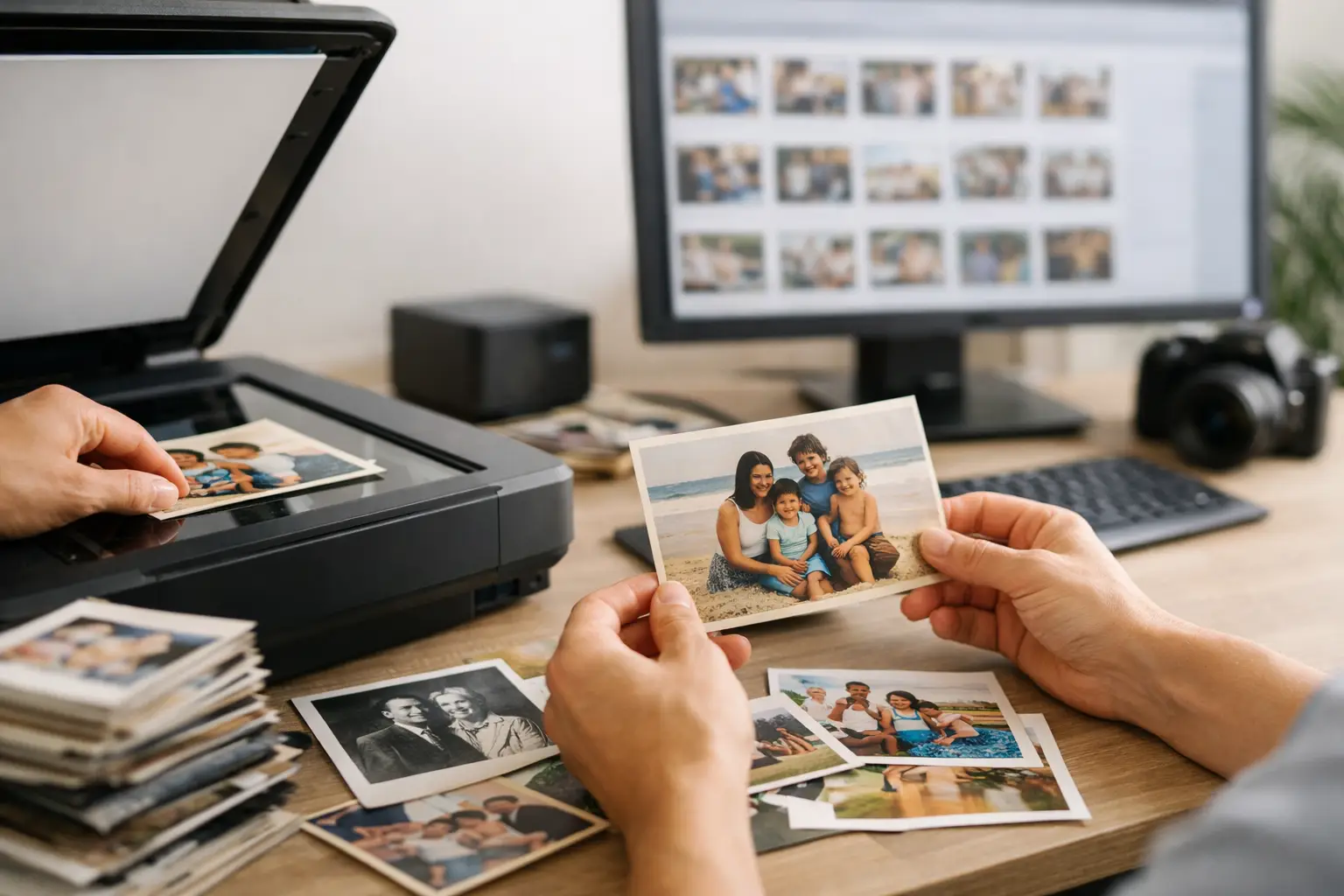
A box of family photos rarely looks urgent until it is. Prints fade in a warm closet. Album pages yellow and stick together. A water leak, move, or estate transition can put decades of family history at risk in a single afternoon. Photo scanning services Los Angeles families choose should do more than turn prints into files. They should help protect the stories those prints carry.
For many Southern California households, photo preservation begins with a practical goal: make copies before something happens to the originals. But the best outcome is more personal. Once photos are digitized, restored when needed, and organized in a usable way, they can be shared with children, included in a memorial, or simply enjoyed again without handling a fragile print.
What photo scanning should accomplish
A scanned photograph is not automatically a preserved photograph. A quick scan at home may be useful for a handful of recent prints, but large or aging collections deserve more care. The purpose of professional digitization is to create clear, dependable digital versions while keeping the originals safe and in order.
That means paying attention to the condition of the photos before scanning. Older prints may be curled, dusty, creased, faded, or attached to album pages. Polaroids, snapshots from the 1960s and 1970s, school portraits, wedding prints, and photographs with handwritten notes on the back can all require different handling.
A thoughtful service also considers how you will use the files after the project is complete. A photo intended for a small phone screen does not need the same resolution as a portrait that may be printed again or shared with multiple family members. Higher-quality scanning creates larger files, so there is a trade-off between maximum detail and easy storage. The right choice depends on the size, condition, and future value of the images.
When photo scanning services are worth it
There is no rule that says every photo collection needs professional help. If you have twenty clean, recent prints and a good flatbed scanner, scanning them yourself may be perfectly reasonable. The decision changes when the collection is large, fragile, disorganized, or emotionally significant.
Professional support is especially helpful when photographs cannot be replaced. That may include the only pictures of grandparents, early family homes, military service, childhood events, or relatives who are no longer living. It can also be useful when an adult child is sorting a parent's belongings or preparing for an estate sale. In these moments, photo preservation is often part of a larger responsibility, and it helps to have a careful process in place.
Local service matters, too. Families seeking photo scanning services in Los Angeles often prefer not to mail irreplaceable originals across the country. Working with a nearby preservation partner offers more confidence about handoff, communication, and the specific needs of a collection. For families in Thousand Oaks and surrounding communities, Photo Renew Labs provides photo digitization and restoration with that local, personal level of care.
Digitization and restoration solve different problems
Scanning and restoration are closely connected, but they are not the same service. Scanning creates a digital copy of the photograph as it exists. Restoration improves visible damage or age-related changes in that digital copy.
A scan may faithfully capture a faded image, a scratch across a face, or discoloration caused by old paper and storage conditions. That accuracy is useful, but it does not always create the image a family wants to share. Restoration can address common issues such as fading, color shifts, dust marks, scratches, tears, stains, and minor creases.
The goal should not be to make an old photograph look artificially new. A good restoration respects the original moment. Skin tones should remain believable, period clothing should not be over-sharpened, and the character of a vintage image should not disappear under heavy editing. Some damage can be improved dramatically; other problems, especially missing detail or severe water damage, have limits. Clear expectations are part of responsible preservation.
Preserve the original, renew the usable copy
The original print still matters, even after it has been scanned. It may include handwriting, dates, stamps, or physical details that add context. It is also the closest connection to the moment when the photograph was made.
Digitization gives the family a working copy for everyday use. You can text it to a sibling, add it to a slideshow, print a duplicate, or store it in more than one place. Restoration gives that working copy a renewed appearance when age or damage is distracting from the people and event in the image. Together, these services reduce the pressure to keep handling the original.
Preparing a family photo collection
You do not need to sort every picture perfectly before seeking help. In fact, waiting for a collection to become perfectly organized can delay a project for years. Still, a little preparation can make the process easier and help your priorities come through.
Start by separating photographs that require extra attention. Set aside torn, faded, water-damaged, or heavily scratched prints. Keep loose notes, envelopes, and album labels with the related photos whenever possible. A note that says “Lake Arrowhead, 1984” may be as valuable to the family archive as the image itself.
Next, identify the photographs you would be most upset to lose. These might be wedding photos, images of older relatives, childhood snapshots, or pictures that exist only once. If the collection is large, beginning with these high-priority images is often more manageable than trying to process every print at once.
Avoid using tape, glue, or household cleaning products to repair photos before scanning. Tape can damage the surface further, and moisture can cause additional problems. Handle prints by the edges with clean, dry hands, and keep them out of direct sunlight while you decide what to preserve first.
Questions to ask before choosing a service
The right provider should be willing to explain its process in plain language. You should understand how originals are handled, what type of files you will receive, and whether restoration is included or priced separately.
Ask whether photographs are scanned individually or processed in batches. Batch processing can be appropriate for clean, standard-size prints, while individual scanning may be better for delicate photos, unusual sizes, or images with damage. Also ask how the provider handles albums. Removing pictures from an old album can sometimes cause harm, so it is worth discussing the safest approach before work begins.
File delivery deserves attention as well. JPEG files are convenient for sharing and viewing, while larger archival-quality formats may be appropriate for photographs that need extensive restoration or future printing. There is no single best format for every family. What matters is receiving files that are clear, accessible, and easy to back up.
Finally, ask how you can review the results. A preservation project should leave you feeling confident, not uncertain about what happened to your photos. Communication is particularly important for restoration work because every family has a different comfort level with changes to a beloved image.
Protect the digital files after scanning
Digitizing photographs is a major step, but the files need care too. Saving everything on one computer is not enough. Devices fail, accounts get locked, and folders become difficult to find when they are never named or organized.
Keep at least two copies of your digital photo collection in separate places. Many families use an external drive at home and a secure cloud storage account as an additional backup. Give folders simple names that make sense years from now, such as “Grandma Rosa 1940s” or “Family Vacations 1985-1995.” If dates are uncertain, use approximate labels rather than leaving files anonymous.
It also helps to share selected copies with trusted family members. Preservation is stronger when more than one person knows the photographs exist, recognizes the people in them, and has access to the stories behind them. A digital archive becomes more meaningful when a child can ask, “Who is that?” and someone can still answer.
Give the collection a future
The value of photo preservation is not limited to disaster prevention. Digitized and restored photographs can become part of family life again. They can be gathered for an anniversary, used in a celebration of life, printed for a grandchild, or shared during a holiday when everyone is together.
You do not have to tackle every box at once. Begin with the photos that carry the most meaning, protect them carefully, and make them available to the people who will treasure them next.