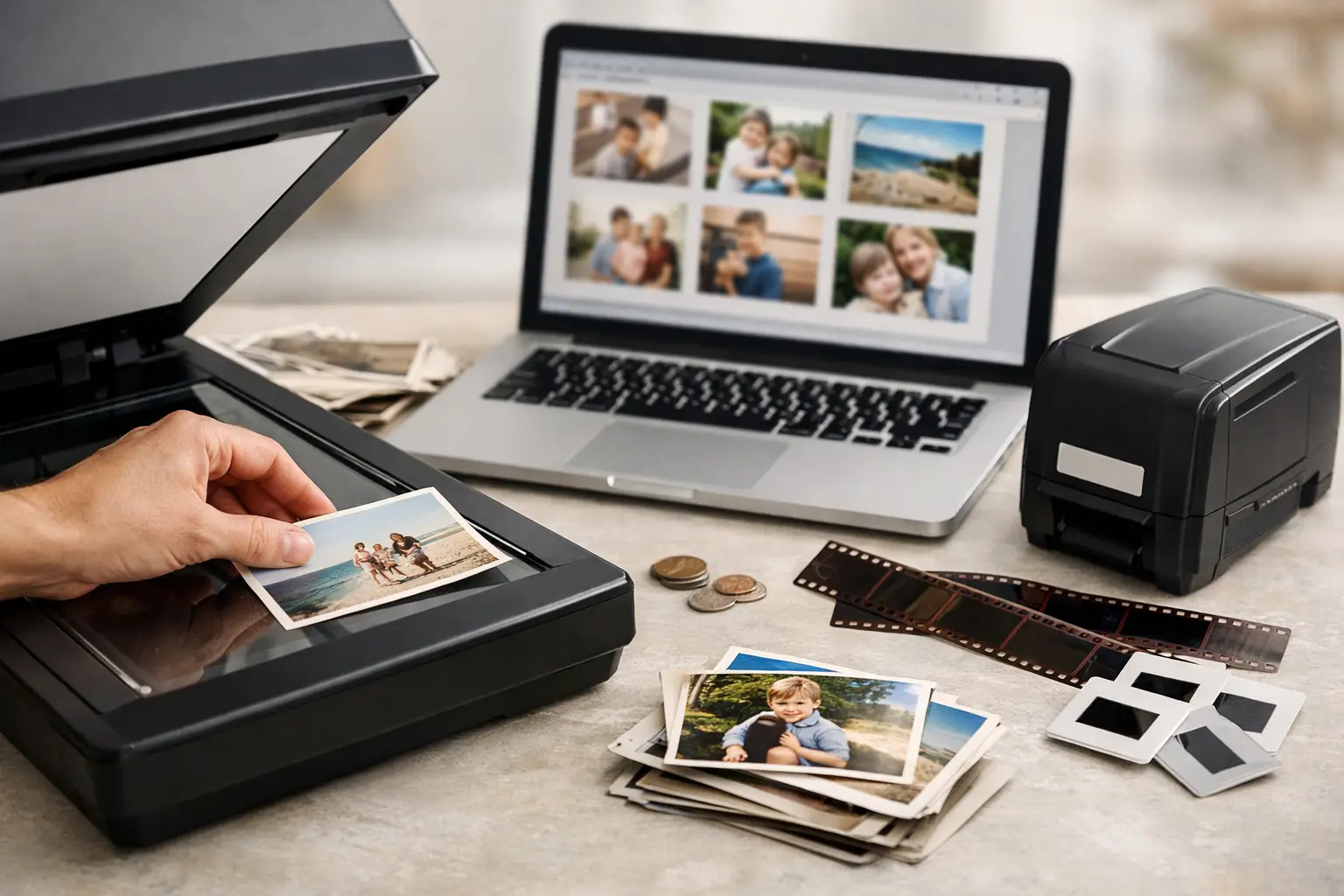
A box of family photos is rarely just a box. It may hold the only pictures of a grandparent as a child, a wedding day, a first home, or people whose stories now depend on those prints. When you search for photo scanning services near me prices, the lowest per-photo rate can look appealing. But the real question is whether the service will create reliable digital copies while treating your originals with the care they deserve.
For families in Thousand Oaks and throughout Southern California, pricing can vary widely because photo collections vary widely. A neat stack of standard 4-by-6 prints is very different from a fragile album, curled snapshots, faded color photos, or a collection that needs meaningful restoration. Understanding what is included helps you compare estimates with confidence.
What photo scanning service prices usually include
Most professional scanning services price projects by the number of photos, although some charge by the box, album, slide, or hour. The basic scanning price generally covers preparing the image, creating a digital file, and delivering the files in an agreed format. The exact level of preparation and quality control matters more than it may seem.
A basic service may scan loose, standard-size prints at a set resolution and provide JPEG files. That can be a practical choice for a large group of photos in good condition when your goal is simple backup and sharing. A preservation-focused service may spend more time removing photos from sleeves, handling delicate prints, scanning at a higher resolution, rotating files correctly, and checking the final images for issues. That additional care affects the price, but it can prevent disappointment later.
Before comparing quotes, ask whether the price includes file naming, organizing photos into folders, duplicate removal, basic color correction, and delivery on a flash drive or other storage device. A low starting price may not include these details. They can be worthwhile add-ons, especially if the goal is to give your family an archive they can actually find and enjoy.
Typical price ranges and why they differ
There is no single local rate for every project, but broad price ranges can help set expectations. Standard loose prints in good condition are often priced by volume. The per-photo cost usually decreases as the quantity rises, so scanning 1,000 prints may cost less per image than scanning 100.
Special formats and complex collections generally cost more. Expect a different quote for photo albums, scrapbook pages, oversized prints, Polaroids, slides, negatives, panoramic photos, framed images, and photos mounted to brittle paper. Each format may need different equipment or more hands-on preparation.
Restoration is typically priced separately from scanning because it is individual image work rather than batch processing. A lightly faded photo may need modest color and contrast adjustment. A torn portrait with stains, missing corners, heavy fading, or damage across a face requires more time and careful judgment. A reputable provider should explain restoration pricing per image or by the level of repair instead of suggesting every photo needs the same treatment.
For many families, the most sensible approach is to scan the full collection first, then select a smaller group of favorites for restoration. This keeps the project manageable while ensuring the photographs most likely to be printed, framed, or shared receive focused attention.
The four factors that shape your estimate
A meaningful quote begins with the collection itself. The number of images matters, but it is only one part of the picture. Four details have the biggest effect on the final cost:
- Format and size: Loose prints are usually faster to scan than albums, slides, negatives, or oversized photographs.
- Condition: Photos that are stuck together, curled, torn, mold-affected, heavily faded, or fragile need more careful handling.
- Organization: A labeled, sorted collection takes less preparation than mixed boxes of photos, memorabilia, duplicates, and empty envelopes.
- Desired outcome: Basic digital backup, high-resolution archival files, organized folders, and restoration each require a different level of work.
These factors are not reasons to avoid digitizing a difficult collection. They simply help set fair expectations. A local professional should be able to look at a representative sample and explain what is practical, what needs special handling, and where you can make choices to stay within your budget.
Resolution, file types, and the value behind the number
A scanning price is only useful when you know what kind of files you will receive. Resolution is measured in dots per inch, or DPI. For standard prints, a good professional scan should be detailed enough for viewing, sharing, and many future reprints. Higher resolution may be appropriate when an original is small, when you may want to enlarge it, or when the image has historical value.
More resolution is not automatically better. Very high-resolution files take more time to create, store, transfer, and organize. If you have thousands of ordinary snapshots, a sensible standard resolution may offer the best balance of quality and cost. For a small portrait of a relative, a wedding photograph, or an image you hope to enlarge, higher resolution can be worth requesting.
Ask whether you will receive JPEG files, TIFF files, or both. JPEGs are convenient for everyday viewing and sharing. TIFF files are larger but can be useful as high-quality preservation files, particularly for images that may be restored or printed later. The right choice depends on your plans, not on a one-size-fits-all package.
When low pricing can become expensive later
A bargain service can be perfectly adequate for photos that are easy to scan and not especially valuable. The trade-off appears when images are mishandled, poorly cropped, scanned at insufficient resolution, or delivered in a confusing folder of unnamed files. Re-scanning a collection can cost more than choosing careful work the first time. Damage to an original cannot always be undone.
Be cautious with pricing that is unclear about shipping, return of originals, order minimums, album removal, file delivery, or turnaround time. If you are working with irreplaceable family photos, local handling offers a practical advantage. You can ask questions, review a sample, and know who is responsible for your collection from drop-off through return.
At Photo Renew Labs, digitization and restoration are treated as connected parts of preserving a family archive. That perspective matters when a collection contains both everyday snapshots and a handful of images that deserve careful renewal.
How to request a useful local quote
You do not need to count every photograph before contacting a service. Start by estimating the number of boxes, albums, loose prints, slides, or negatives. Take a few photos of the collection and note any special concerns, such as water damage, faded color, old adhesive, or pictures you want restored.
Then describe what you want at the end of the project. Do you need a secure digital backup? A folder organized by decade or family branch? A set of restored photographs for a memorial, anniversary, or family reunion? Clear goals help a provider recommend the right service level instead of quoting a generic package that may not fit.
It is also reasonable to ask for a sample scan. Seeing the quality of one or two images can clarify resolution, cropping, color treatment, and file naming before you commit to a larger project. For a collection with damaged photos, ask for an example of restoration work as well. Restoration should improve an image while respecting its original character, not make a family photograph look artificial.
Choosing value for memories that cannot be replaced
The best choice is not always the lowest estimate or the most elaborate package. It is the service level that protects your originals, produces files you will be able to use, and gives appropriate care to the photographs that matter most. A straightforward batch scan may be right for one box. An organized archive with selective restoration may be right for another.
Begin with the photos you would be most upset to lose. Getting those images safely digitized gives your family a foundation for sharing, printing, and preserving the stories behind them for years to come.